
The Charism of Fatherhood: What a father gives, and what is given back

There is a question every father carries, even when he cannot articulate it: Is it taking hold?
He watches his child receive the Eucharist for the first time. He sits beside them at the dinner table and listens to what they say about a friend who is struggling. He catches them, unprompted, making the Sign of the Cross. And in those moments — ordinary, unannounced — he catches a glimpse of something he did not earn and cannot fully claim. Grace. Moving through his child, back toward him, back toward God.
Jesus tells us: receive the Kingdom of God like a child (Mark 10:15). It is an instruction to all of us. But to a father, it arrives as a kind of revelation: the child who receives the Kingdom so naturally is his most immediate teacher in how to receive it himself.

What a Father Carries
John the Apostle writes from exile, old and far from those he formed in the faith, and what he names as his greatest joy is not his own fidelity. It is theirs. I have no greater joy than to hear that my children are walking in the truth (3 John 1:4).
This is the charism of fatherhood — generative and something more, moving from father to child and back again transformed. What a father gives, his child's reception transforms into something that did not exist before the child received it. The man who stands at the altar beside his children is not only offering them formation. He is being formed by what their openness makes possible — a form of grace that belongs to the relationship itself, and could not have come into being any other way.
Fathers extend this invitation in ways both deliberate and unrealized — with each Mass attended, each sacrament received together, each moment of faith lived openly rather than privately. Often it is simply a presence: this is what I do, this is what I am, this is where I stand. And into that presence, something enters that is larger than either of them.
The love of Jesus is breathed into a father as he tends his children. It is reflected back through them — renewed, deepened, arriving in a form it could not have taken alone.
A Desert, a Wound, and a Hope
In the heart of the Chihuahuan Desert, in the northern Mexican state of Coahuila, there is a community called Cuatro Ciénegas, consecrated to St. Joseph. It is a place of extraordinary natural beauty — ancient pools fed by underground springs, desert grasses moving in waves across the valley floor, mountains encircling the town like the walls of something protected.
It is also a community carrying a wound.
Roughly forty percent of its families are fatherless. Men driven out by addiction, by despair, by scarce work and the terrible logic that says: go elsewhere, send money back, that is enough. They leave behind wives and children who carry what was meant to be shared. The wound runs deeper than economics. It is spiritual. A child without a father's presence grows up without a particular kind of witness — not the only witness, but an irreplaceable one.
Catholic World Mission, in partnership with the Lumen Institute and Plan 2040, is working at the center of this wound. The St. Joseph Fatherhood Initiative was born in this place, from this need. Its vision is simple and radical: every father as an active presence in his family's life and faith — beside his children at the table, beside them in their struggles, beside them in the pew. The model is St. Joseph, the man who said nothing recorded in Scripture and whose entire witness was his fidelity. Present. Steady. Shaped by what he protected.
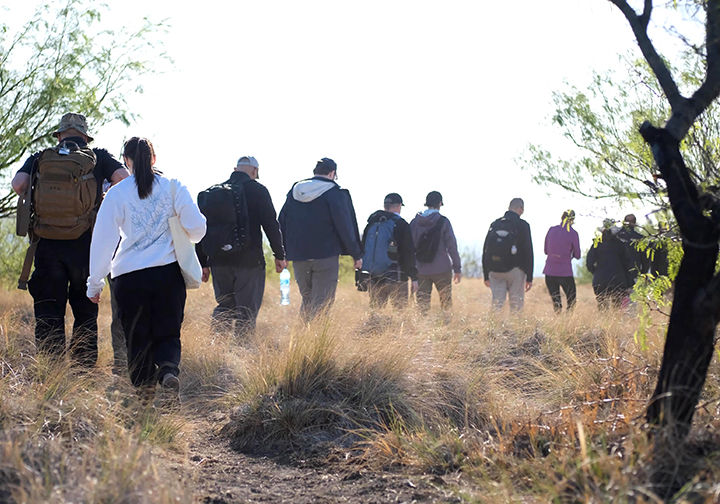
Fr. Daniel Brandenburg leads the Camino de San José through this desert — fourteen stations, twelve miles, each one an invitation to encounter the man Joseph was and to ask: what would it mean to live more like him? Men who walk that path go home changed. Not because the desert instructs them but because it holds them long enough for what is already true to become visible.


The Reflection That Returns
The fathers being formed through the St. Joseph Fatherhood Initiative are finding their way back from real rupture — absence, addiction, the slow erasure of a man's sense of what he is for. What they are discovering on the other side of that rupture — though the path that leads there differs — is what every father glimpses in these ordinary moments: that what they give their children does not disappear into them. It comes back. Transfigured. The child walking in the truth gives the father something he could not have arrived at alone — a joy rooted in witness, not achievement. The grace moving through his child is the same grace that was moving through him. It has simply found a new face.
This is what Catholic World Mission enters into when it walks alongside fathers. Not repair work, but recognition — the recognition that fatherhood, lived in faith, is one of the places where Christ's merciful communion becomes most immediately visible. Father gives. Child receives. Grace returns. The bridge between them holds.
On this Father's Day, we celebrate that charism in every father who has stood at the altar, at the bedside, at the table, and offered what he had — knowing it would be transformed by the one who received it.
And we invite you to learn more about the fathers of Cuatro Ciénegas, and the work being done, quietly, in the desert, to call that charism forth.

James Flanagan
Executive Director,
Catholic World Mission
Get Involved with the Catholic World Mission Family
MAKE A DIFFERENCE TODAY


Comments